- Study Abroad
- / ielts
- / waking up in a nightmare reading answers
Waking up in a Nightmare Reading Answers


Author
17-09-2025

This article contains “waking up in a nightmare” reading answers as an illustration for the IELTS reading practice test. This article consists of 13 questions based on the given passage in 2 different types namely- 8 questions as matching headings and 4 questions as yes, no or not given.
Check out our YouTube Channel to Practice Full-Length IELTS Reading Tests Daily

Table of content:
- Solution for waking up in a nightmare
- Waking up in a nightmare IELTS reading practice test
- Passage
- Questions
- Answers with explanation
Solution for Waking up in a Nightmare
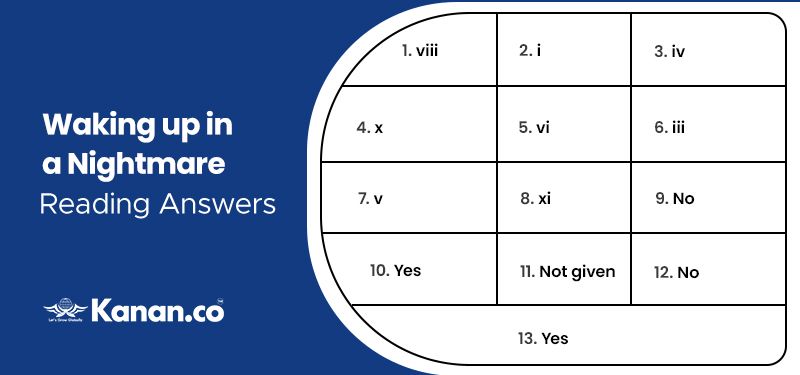
Here the answers for waking up in a nightmare reading answers is given below in a table form.
Answers Table
| 1. viii | 4. x | 7. v | 10. Yes | 13. Yes |
| 2. i | 5. vi | 8. xi | 11. Not given | |
| 3. iv | 6. iii | 9. No | 12. No |
Waking up in a Nightmare IELTS Reading Practice Test - Exam Review
We have given the waking up in a nightmare IELTS reading answers, as a sample article for the IELTS reading practice test. Use this article while practicing for your major exam, it will aid you to crack your exams with band scores. Go through the given passage and answer the questions.
Passage
We have given waking up in a nightmare reading answers with location. Be careful while reading the passage and answer the questions.
Waking up in a nightmare reading answers
A. Imagine the following. It happens out of nowhere: one second you're fast asleep, then, with a snap, you're suddenly wide awake. The room around you is dark, but you can feel a presence lurking in the shadows, somehow, you know it intends to harm you. As it draws closer you try to scream for help, but the words remain stuck in your throat. You try to raise your arms, reach for the bed covers and drag yourself off the mattress, but your fingers refuse to move. Your heart beats rapidly: you feel like you're choking. Then a few minutes later, out of the blue, it stops. You're back in control of your body and you can finally move again.
B. Many people who suffer from chronic sleep paralysis begin to experience the phenomenon in early childhood, though the disorder can strike a any stage of life. Sufferers may think they are alone in their suffering, though recent studies reveal that this is far from the case. According to a study published by Sleep Medicine Reviews, around 8% of the population has suffered through the experience of sleep paralysis at least once in their lives with that number climbing to nearly 30% for psychiatric patients and, curiously, students. (Although that might have more to do with the average age of a student rather than a person's inclination towards academia.)
C. A separate study conducted by James Cheyne, a psychologist at the University of Waterloo, suggests that the number of those in the general population who experience sleep paralysis at least once is closer to 40%-with up to 6% experiencing regular incidents of sleep paralysis
D. So what is sleep paralysis, exactly? To this day, scientists fail to agree on a satisfactory definition, though throughout history there have been a variety of differing hypotheses. Among other things, sleep paralysis has been attributed to demons, ghosts, aliens, or even malevolent female horses riding on sleepers' chests. The Chinese use a name that roughly translates as "Ghost Depression" for it, while the Turks call it "The Dark Presser". In German, the mare who was said to cause it was known as the Nachtmahr-which, as you may be able to guess, is where the English word 'nightmare' comes from.
E. Sleep paralysis has been heavily documented in art, too: Herman Melville's novel Moby Dick is a notable example, as well as the 1781 Henri Fuseli painting, The Nightmare, which portrays a woman lying on her back with a demon perched atop her and a sprite lurking in the background. More recently, Rodney Ascher's 2015 docudrama The Nightmare uses a range of special effects in an attempt to convey to viewers the often terrifying sensations experienced by those who suffer from sleep paralysis.
F. Though a resounding definition for sleep paralysis is still yet to be found, we do know that sleep paralysis occurs during REM sleep when our muscles are locked and cannot move. Presumably, this is to prevent us from acting out our dreams and lashing out in real life. In the vast majority of cases, sleep paralysis is completely harmless-though it certainly might not feel that way for the sufferer. Symptoms may vary quite widely; some people can open their eyes while others can't; some people sense a foreign presence near them; while some experience more vivid hallucinations, such as "a little vampire girl with blood coming out of her mouth", as Brian Sharpless, a clinical psychologist at Washington State University, describes one of his patient's recurring experiences.
G. Surprisingly, sleep paralysis holds the possibility for a pleasant experience, too. Jorge Conesa Sevilla, a psychologist at Northland College, believes sleep paralysis sufferers can be taught over time to remove themselves from their panic-stricken state while retaining the waking levels of awareness they experience during sleep paralysis, which would allow sufferers to turn a sleep paralysis incident into one of 'lucid dreaming', that is, a dream where the dreamer not only is aware that they are dreaming but can also exert some degree of control over the dream and manipulate it to their liking. Lucid dreams allow one to direct and act out impossible fantasies, experience the impossible, and take control of their dreams.
H. For those who are less interested in mastering lucid dreaming. and simply want to stop experiencing sleep paralysis, there are a few things which can be done to lower the chances of an episode of sleep paralysis. Sleep paralysis is associated with irregular sleeping patterns and sleep deprivation As such, making sure to get at least six hours of sleep every night can help, as can regularly going to sleep at the same time. Avoiding large meals or exercise in the evening is also helpful, and so is making sure your sleeping environment is dark, quiet, comfortable, and has a slightly cool temperature. Sleeping on your side is also less likely to trigger a sleep paralysis episode than lying on your back, so this is also often recommended to sufferers. Some sufferers find that simply reminding themselves that the experience, though it may be extremely scary, is not capable of causing them harm, helps to calm them when they find themselves experiencing an episode of sleep paralysis.
Questions
Questions 1-8
- Reading Passage 1 has eight paragraphs, A.
- Choose the correct heading for each paragraph from the list of headings below.
i. Who is affected?
Il. Sleep paralysis defined
iii. Examples of different experiences
iv. Four out of ten know what it's like
v. The silver lining for sufferers
vi. Famous depictions
vii. A contradictory thought
viii. The experience of sleep paralysis
ix. A terrifying exercise
x. Cultural interpretations
xi. Tips to reduce episodes of sleep paralysis
Questions 9-13
- Do the following statements reflect the claims of the writer in Reading Passage 1?
- YES - if the statement reflects the claims of the writer
- NO - if the statement contradicts the claims of the writer
- NOT GIVEN - if it is impossible to say what the writer thinks about this
9. There is a link between someone's education and the likelihood of experiencing sleep paralysis.
10. Germans blamed evil female horses for sleep paralysis in the past.
11. The novelist Herman Melville wrote about his experience with sleep paralysis.
12. Sleep paralysis is a potentially dangerous condition.
13. The way you position yourself when you sleep can trigger a sleep paralysis incident.
Answers for waking up in a nightmare with explanation
Answers for waking up in a nightmare reading answers with explanations are given here, this will help you identify your errors while answering.
1. Answer: viii
Explanation: “Imagine the following. It happens out of nowhere: one second you're fast asleep, then, with a snap, you're suddenly wide awake. The room around you is dark, but you can feel a presence lurking in the shadows, somehow, you know it intends to harm you…”. With this line it is clear that paragraph A states about the experience of sleep paralysis. Hence the given answer is located under paragraph A.
2. Answer: i
Explanation: “Many people who suffer from chronic sleep paralysis begin to experience the phenomenon in early childhood, though the disorder can strike a any stage of life. Sufferers may think they are alone in their suffering, though recent studies reveal that this is far from the case”. With this line it is clear that paragraph B matches with the heading who is affected?. Hence the given answer is located in the 1-4 lines of paragraph B.
3. Answer: iv
Explanation: “ A separate study conducted by James Cheyne, a psychologist at the University of Waterloo, suggests that the number of those in the general population who experience sleep paralysis at least once is closer to 40%-with up to 6% experiencing regular incidents of sleep paralysis”. With this line it is clear that paragraph C matches with the heading four out of ten know what it's like. Hence the given answer is located under paragraph C.
4. Answer: x
Explanation: “ To this day, scientists fail to agree on a satisfactory definition, though throughout history there have been a variety of differing hypotheses. Among other things, sleep paralysis has been attributed to demons, ghosts, aliens, or even malevolent female horses riding on sleepers' chests. The Chinese use a name that roughly translates as "Ghost Depression" for it, while the Turks call it "The Dark Presser". With this line it is clear that paragraph D matches with the heading Cultural interpretations. Hence the given answer is located in the 1-6 lines of paragraph D.
5. Answer: vi
Explanation: “Sleep paralysis has been heavily documented in art, too: Herman Melville's novel Moby Dick is a notable example, as well as the 1781 Henri Fuseli painting, The Nightmare, which portrays a woman lying on her back with a demon perched atop her and a sprite lurking in the background”. With this line it is clear that paragraph E matches with the famous depictions. Hence the given answer is located in the 1-4 lines of paragraph E.
6. Answer: iii
Explanation: “Symptoms may vary quite widely; some people can open their eyes while others can't; some people sense a foreign presence near them; while some experience more vivid hallucinations, such as "a little vampire girl with blood coming out of her mouth", as Brian Sharpless, a clinical psychologist at Washington State University, describes one of his patient's recurring experiences”. With this line it is clear that paragraph F matches with the heading examples of different experiences. Hence the given answer is located in the last 5 lines of paragraph F.
7. Answer: v
Explanation: “Surprisingly, sleep paralysis holds the possibility for a pleasant experience, too. Jorge Conesa Sevilla, a psychologist at Northland College, believes sleep paralysis sufferers can be taught over time to remove themselves from their panic-stricken state while retaining the waking levels of awareness they experience during sleep paralysis, which would allow sufferers to turn a sleep paralysis incident into one of 'lucid dreaming', that is, a dream where the dreamer not only is aware that they are dreaming but can also exert some degree of control over the dream and manipulate it to their liking”. With this line it is clear that paragraph G matches with the heading the silver lining for sufferers. Hence the given answer is located in the 1-7 lines of paragraph G.
8. Answer: xi
Explanation: “there are a few things which can be done to lower the chances of an episode of sleep paralysis. Sleep paralysis is associated with irregular sleeping patterns and sleep deprivation As such, making sure to get at least six hours of sleep every night can help”. With this line it is clear that paragraph H matches with the heading a terrifying exercise. Hence the given answer is located in the 2-5 lines of paragraph H.
9. Answer: No
Explanation: “Sufferers may think they are alone in their suffering, though recent studies reveal that this is far from the case”. With this line it is clear that the given statement contradicts the given information. Hence the given answer is located in the 3-4 lines of paragraph B.
10. Answer: Yes
Explanation: “In German, the mare who was said to cause it was known as the Nachtmahr-which, as you may be able to guess, is where the English word 'nightmare' comes from”. With this line it is clear that Germans blamed evil female horses for sleep paralysis in the past. Hence the given answer is located in the last 3 lines of paragraph D.
11. Answer: Not given
12. Answer: No
Explanation: “In the vast majority of cases, sleep paralysis is completely harmless-though it certainly might not feel that way for the sufferer”. With this line it is clear that the given statement contradicts the given information. Hence the given answer is located in the 4-5 lines of paragraph F.
13. Answer: Yes
Explanation: “Sleeping on your side is also less likely to trigger a sleep paralysis episode than lying on your back, so this is also often recommended to sufferers”. With this line it is clear that the way you position yourself when you sleep can trigger a sleep paralysis incident. Hence the given answer is located in the 8-9 lines of paragraph H.
Other reading answers

About Author Gayathri Nagarajan
Gayathri, a trusted study-abroad expert, with expertise in standardized tests like IELTS, TOEFL, PTE, GRE, and GMAT. With a strong tech background from SASTRA University, she excels in software testing and has a passion for content writing and digital marketing. She aids students in finding the perfect academic fit, offering guidance on course selection, LOR and SOP writing. She remains up-to-date with the latest trends in higher education, delivering credible, accurate information on international education, including courses and test prep materials. As a trusted Study abroad expert at Kanan International, explore her latest blogs and articles for comprehensive insights into studying abroad and realizing your academic aspirations.
Kanan.co is a trusted study abroad consultancy offering comprehensive services, resources, and solutions for students and education institutions. We support students at every stage of their global education journey, ensuring a smooth and guided experience. Along with test preparation for IELTS, GRE, TOEFL, and SAT, we provide expert services such as SOP writing, visa guidance, accommodation support, scholarship assistance, and education loan support. Our expertise and commitment to excellence make us a reliable partner for students pursuing international education.
Free Online Mock Test 2026
Practice our mock test worth Rs. 25000 for Free and know your IELTS score!








Global Headquarters
Kanan Int EdTech Inc
320 Bay Street, Suite 321 (Spaces), Toronto ON, Canada M5B 1N9
Indian Headquarters
Kanan International Pvt. Ltd.
D-wing, 2nd Floor, Trident Complex, Ellora Park Vadiwadi Road, Vadodara, Gujarat 390007
IT/ Digital Campus
Kanan International Pvt. Ltd
Old, New No 3, 2nd Floor, 1A, Dr Sadasivam Rd, T. Nagar, Chennai, Tamil Nadu 600017
Our branches
- Bardoli
- Bharuch
- Chennai
- Dehradun
- Gurugram
- Himatnagar
- Karnal
- Nadiad
- Navsari
- Palanpur
- Rajkot
- Vadodara
- Valsad
- Vallabh Vidyanagar
- Vapi
Study Abroad
Test Prep
Top Universities
Consultants
IELTS Centers
GRE Centers
TOEFL Centers
SAT Centers
Language Courses in Vadodara
SOP Blogs
Featured Blogs
Study Abroad Consultants in Chennai
Study Abroad Consultants in Surat
Study Abroad Consultants in Navsari
Study Abroad Consultants in Bardoli
Study Abroad Consultants in Ahmedabad
Study Abroad Consultants in Anand
Study Abroad Consultants in Khanna
Study Abroad Consultants in Nadiad
Study Abroad Consultants in Vadodara
Study abroad consultants in Valsad
Copyright © 2026 KANAN.CO All rights reserved.